The ladder of knowledge: from the senses to understanding the universe
14.08.2026
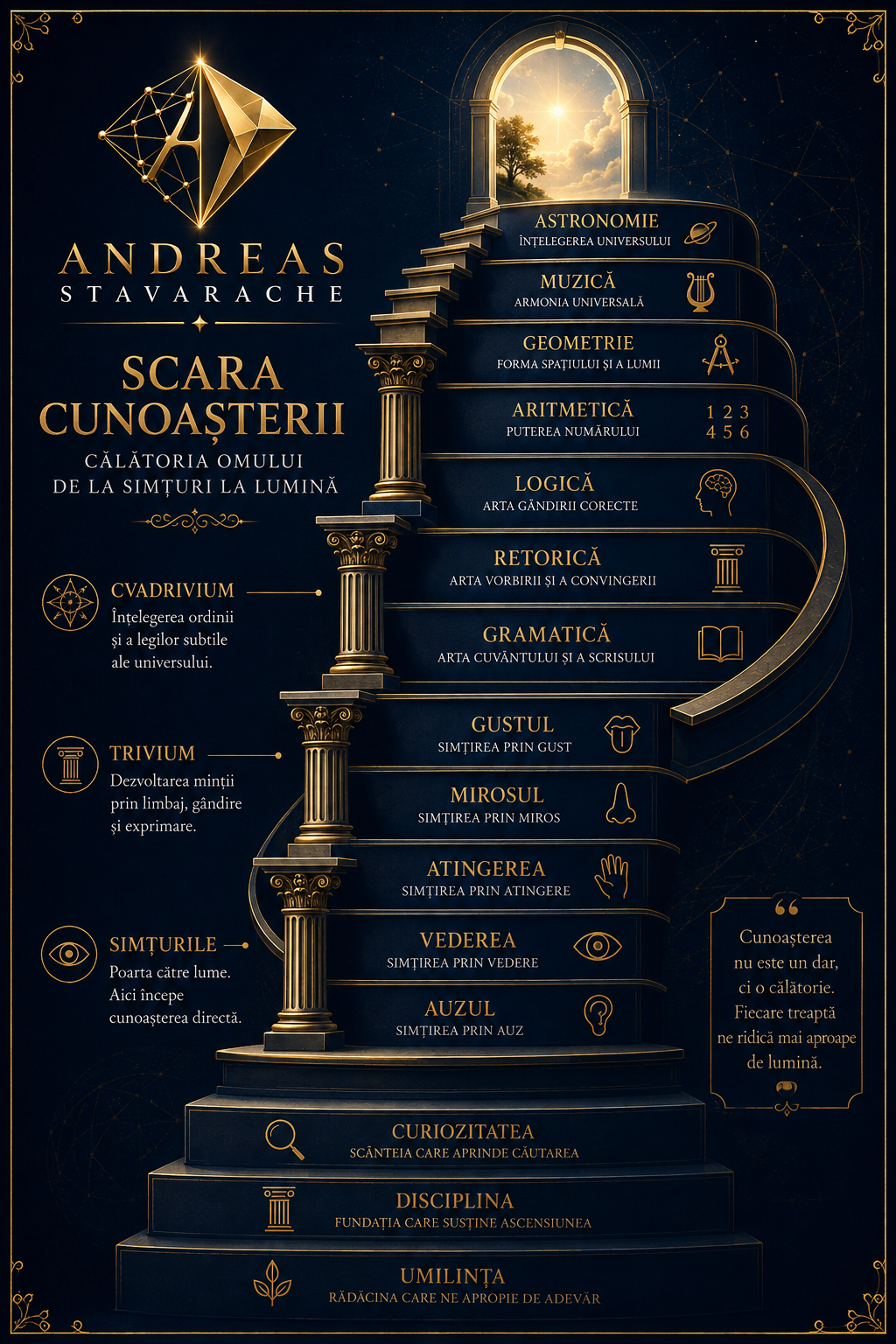
Look at this image not merely as a ladder, but as a representation of how a human being comes to know the world.
We are not born knowing. We do not arrive in the world with logic already formed, with mathematics understood, or with the answers about the universe already in our minds. At first we observe. We hear. We see. We touch. We smell. We taste.
And slowly, out of everything we experience, we begin to build knowledge.
That is precisely why the senses stand at the foot of this ladder.
The first step: the senses — our contact with the world
Hearing, sight, touch, smell and taste are our first instruments of exploration.
Before we know how to explain what fire is, we see its light and feel its heat. Before we understand what music is, we hear it. Before we can define the beauty of a flower, we see its shape, notice its colour and smell its scent.
That is how our relationship with reality begins: through experience.
But the senses are not enough.
They tell us that something exists, yet they do not always explain why it exists, how it works, or what relationship it has to everything else.
And so we climb a step.
Grammar — we learn to name the world
Once we perceive things, we need words in order to describe them.
This is where grammar appears.
It may seem ordinary, but language enormously changes a person's capacity to think. The moment we can name a phenomenon, we can analyse it, compare it, and pass it on to someone else.
We no longer have only the experience. We have the concept as well.
We begin turning what we see into what we can think.
Rhetoric — we learn to convey what we think
Having words is not enough. We have to know how to build with them.
Rhetoric is the capacity to express an idea in such a way that another person can understand it.
Here appear argument, explanation, discourse — the ability to convey a perspective.
But there is also a danger.
A person can speak extraordinarily well and still say something false. Many philosophers and critics often stand at this rung; their level of awareness is searching for its meaning and its balance.
They can convince without proving.
That is why one of the most important steps on the whole ladder comes next.
Logic — not everything that sounds good is true
Logic forces us to ask simple but essential questions: “How do I know this?”, “What is the evidence?”, “Does my conclusion actually follow from the premises, or do I simply like believing it is true?”, “Are there other possible explanations?”, “What would an intelligent person who disagrees with me say?”
Through such questions, logic teaches us something uncomfortable but extremely valuable: not to confuse conviction with truth. We can believe firmly in an idea and still be wrong.
The ability to correct ourselves is not an intellectual weakness. On the contrary, it is one of the clearest forms of maturity.
These three disciplines — grammar, rhetoric and logic — formed what classical education called the Trivium.
From here, however, another stage begins. It is no longer only about how we think and how we express ourselves, but about the attempt to understand the order of things.
Arithmetic — the discovery of number
And so we arrive at number.
Arithmetic studies quantity and the relationships between numbers.
And here something genuinely fascinating appears.
Number no longer depends on the way we perceive things.
If we have three objects, that quantity remains three, regardless of whether the person looking at them is happy or sad, rich or poor, a believer or a sceptic.
Number has this power to remain stable, beyond our inner states.
It allows us to measure, to compare, to build and to verify.
From this point begins one of the greatest adventures of human thought: the attempt to discover the order of reality through the language of mathematics.
Geometry — number takes on form
If arithmetic studies number, geometry shows us how mathematical relationships appear in space.
The point becomes a line. The line becomes a surface. The surface becomes form.
Proportions, symmetries, distances and structures appear.
Geometry enters architecture, art and engineering, and becomes a way through which we understand and measure the world.
This is also where the columns in the image come from: Tuscan, Doric, Ionic, Corinthian, Composite.
They are not there by accident.
Architecture is the place where mathematics, proportion, function and beauty meet.
Music — when number becomes harmony
It may seem strange to the modern mind to find music placed beside arithmetic and geometry. Some people do not believe in music therapy, or in the therapy of the sounds we draw out of words and expression.
But there is an extraordinary idea behind this placement.
Music is not only emotion. It is also ratio.
Rhythm, frequency, interval, proportion.
The sounds we perceive as harmonious can be studied through the relationships between frequencies.
What the ear perceives as music may have behind it a structure that can be measured.
And so a very beautiful idea appears: sometimes we feel order before we are able to explain it.
Astronomy — we raise our eyes to the universe
At the top of the ladder stands astronomy.
After a person learns to observe, to name, to argue, to think logically, to count, to measure forms and to understand the relationships between things, they naturally raise their eyes to the sky.
That is where the truly great questions begin.
What are the stars?
How do the planets move?
Is there an order in the universe?
What is our place in this immensity?
Astronomy becomes, symbolically, the moment when all the intellectual instruments built on the previous steps are turned towards the cosmos.
Grammar, rhetoric and logic made up the Trivium; arithmetic, geometry, music and astronomy formed the Quadrivium.
Together they represented the seven liberal arts of the classical and medieval educational tradition.
But the image suggests something else as well.
At the top there is no answer. There is light.
Look at the last part of the ladder.
There is no closed book with “The Truth” written on it.
There is light.
For me, this is the most powerful symbol in the image.
The higher we climb in knowledge, the more aware we should become of how much there is still left to discover.
Genuine knowledge should not produce arrogance. It should produce curiosity, discipline and a certain intellectual humility.
That is why I placed these three ideas at the foundation of the image.
Curiosity makes us ask.
Discipline makes us continue when the answer does not come immediately.
Humility allows us to say: “It is possible that I do not yet know”, or even “It is possible that I was wrong”.
And perhaps that is exactly where real knowledge begins.
But where does numerology stand in this discussion?
For me, a far more interesting question appears here than the simple confrontation between “I believe” and “I don't believe”.
People have been fascinated by numbers, proportions and patterns for thousands of years.
Mathematics has demonstrated incontestably that certain numerical relationships describe phenomena of reality with extraordinary precision.
But from here we must make a very important distinction.
The fact that number is fundamental in mathematics and in the scientific description of nature does not automatically demonstrate the numerological interpretations of number.
These are two different claims.
And it is precisely that difference I find fascinating.
Because the serious question should not be: “Do you have to believe in numerology?”
But rather: what exactly can numerology demonstrate?
If we claim that certain calculations made from a date of birth are associated with particular characteristics, behaviours or life patterns, then an extraordinary challenge appears: to test them.
To observe.
To compare.
To verify.
To see where it works and where it does not.
To look for the exceptions.
To separate personal experience from what can be demonstrated objectively.
For me, this is a far more mature way of approaching numerology than simply asking someone to believe.
I myself have found, through numerology, explanations that helped me understand certain experiences, emotions, choices and periods of my life. Precisely because I recognise that value, I believe the difficult questions should not be avoided.
On the contrary. They should be asked.
Because if an idea contains truth, good questions should not destroy it. They should help us discover which part of it is true, under what conditions, and how far we can go with our claims.
This, for me, is the real ladder of knowledge.
Not the road from “I don't know” to “I know everything”.
But the road from:
I feel → I observe → I ask → I think → I measure → I verify → I understand → I keep searching.
Because perhaps the most dangerous position is not that of not knowing.
It is believing we have nothing left to find out.
Knowledge is not a gift received once. It is a journey. And every step climbed with an open mind can bring us a little closer to the light.
Andreas Stavarache
Ți-a fost de folos articolul?
Un singur click — mă ajută să scriu mai mult din ce contează pentru tine.